

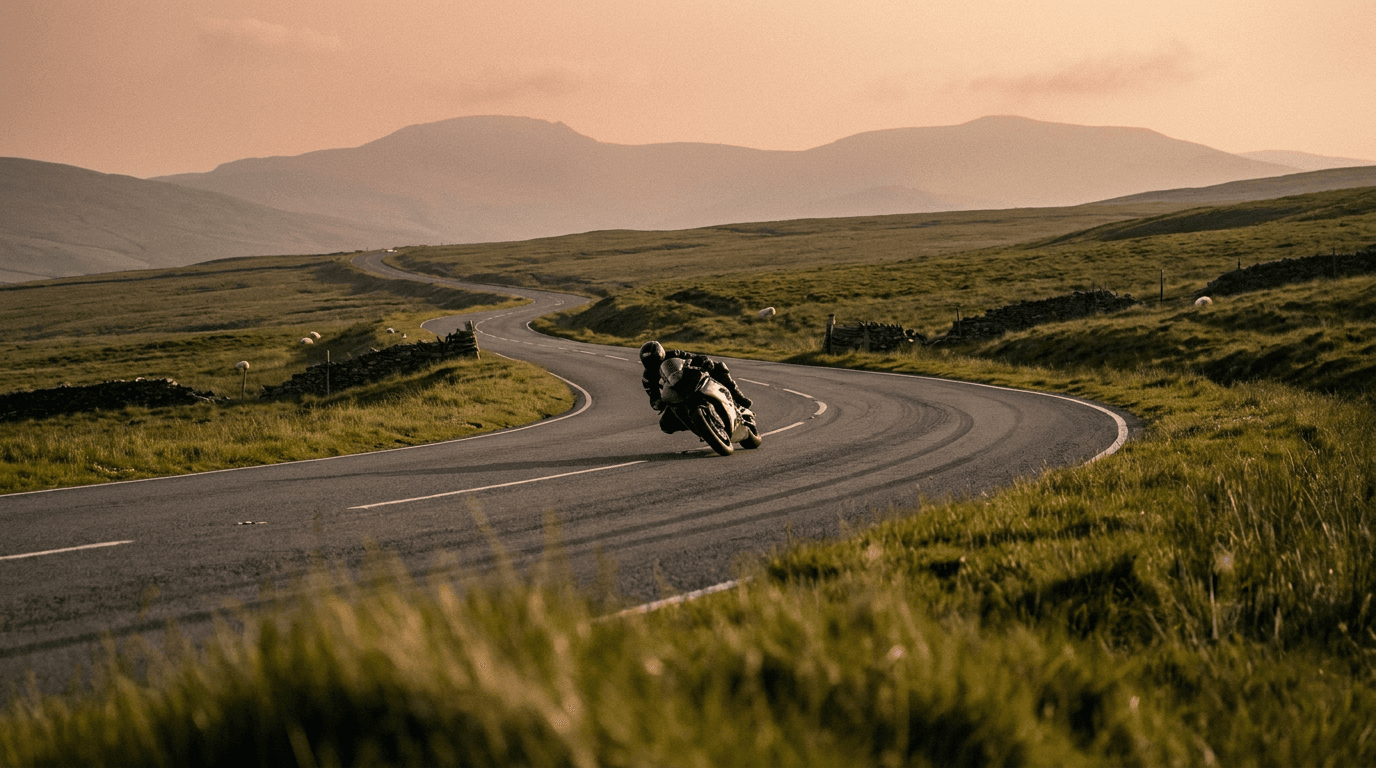
Discover the Isle of Man's Motorcycle Heritage
Where the world's oldest motorcycle road race still runs at full pace — the Isle of Man TT is the most uncompromising motorsport event on earth.
Overview
The Isle of Man is the world's most uncompromising motorcycle destination — a place where the TT, the most dangerous and prestigious motorcycle road race on earth, has been running since 1907. The Mountain Course covers 37.73 miles of closed public roads winding through villages, over Snaefell, and back to Douglas. Average lap speeds now exceed 135mph on roads that are open public roads the rest of the year. There's nothing else like it in motorsport, and the TT alone gives the Isle of Man a place in racing history that no other location of its size can claim.
The wider scene is shaped by the TT and the unrestricted speed laws on parts of the island. The mountain section of the A18 has no speed limit, making it one of the few places in Europe outside the German autobahn where you can legally drive a performance car at the speeds it was built for. Most of the year, the TT course is open to traffic — driving it gives a sense of what the racers experience that no other circuit can replicate.
Why Visit Isle of Man
What makes Isle of Man a must-visit destination for motorsport and automotive enthusiasts
The Isle of Man TT
The most demanding road race in motorsport. The Isle of Man TT (Tourist Trophy) has run on the island's public roads since 1907 — a 37.73-mile Mountain Course from Douglas through Quarter Bridge, Glen Helen, Ballaugh, Ramsey, the Mountain section (Bungalow, Brandywell), and back to the start. Riders average 130mph+ around stone-walled village streets, blind crests, and the 200mph Sulby Straight. Modern lap record: Peter Hickman's 16:42.778 (135.452mph average) on a BMW M1000RR. The TT runs as a two-week event (Practice Week + Race Week) at the end of May / early June. Genuinely dangerous — fatalities are part of the sport's history and culture. Hotels and ferries book out 12+ months ahead; book accommodation before flights. Indescribable atmosphere.
Driving the TT Mountain Course (A18)
Outside race fortnight, the TT Mountain Course is a normal public road network you can drive yourself. The 37.73-mile loop takes 90 minutes to drive at sensible speeds (roughly 30mph average vs the racers' 135mph). Named landmarks are still signed: Quarter Bridge, Bray Hill, Ago's Leap, Ballacraine, the legendary Ballaugh Bridge jump, Ramsey Hairpin, the Gooseneck, the Verandah, the Bungalow, Brandywell, Windy Corner, Kate's Cottage, the 33rd Milestone, Creg-ny-Baa, and Hillberry. Painted kerbs, course numbers, and corner-name signs remain visible. Drive it counterclockwise (the racing direction) to understand rider commitment. Best driven in your own car shipped via the Steam Packet ferry from Liverpool or Heysham.
Manx Grand Prix and Southern 100
Beyond the TT, the Isle of Man has a year-round road racing calendar. The Manx Grand Prix (August-September) uses the same Mountain Course as the TT but is for amateur and classic riders — "where the TT journey begins," with newcomer races and Classic categories for pre-1989 machinery. The Southern 100 (July) runs on the 4.25-mile Billown Course around Castletown in the island's south — friendly mass-start road racing with 100-mile feature races. The Pre-TT Classic (May) and Post-TT (June) races bookend the main event with vintage motorcycle racing on Billown. Combined, the calendar makes the Isle of Man a 5-month road racing season — not just two weeks in June.
The A18 Mountain Road and Snaefell
The Isle of Man has no national speed limit on derestricted ("national speed limit applies") roads — a unique British Isles position. The A18 Mountain Road from Ramsey to Douglas is the famous unrestricted section, with the Snaefell summit (the island's highest point at 621m) accessible via the Mountain Railway. Honest framing: this is not a speed-tourism playground. Police actively patrol for dangerous driving (separate from speed), local traffic uses the road normally, mountain weather changes rapidly (fog can drop visibility to 20m within minutes), and the road has stone walls and blind crests throughout. Drive it for the geography and the freedom, not for top speed. The road closes during TT race sessions; check current schedule. Best driven April-October.
Manx Motor Museum and Jurby Transport Heritage
Two essential automotive museum stops. The Manx Motor Museum (Jurby, in the island's north) holds 500+ classic cars, motorcycles, and TT memorabilia in a working hangar setting — the world's largest collection of TT-winning motorcycles, plus rare British marques (Vauxhall Prince Henry, MG K3, Aston Martin DB4). The Jurby Transport Museum next door focuses on commercial vehicles, buses, and Manx transport heritage. Plus the Isle of Man Motor Museum in Jurby Mill (a separate venue), the Steam Railway Museum in Port Erin (Victorian-era preservation), and the Manx Electric Railway running narrow-gauge electric trams from 1893. Genuine niche automotive depth that makes a full day's visiting alongside the road racing.
Manx Classic Car Touring
The Isle of Man has a surprisingly strong classic car touring identity beyond the motorcycle TT. The annual Manx Classic Car Tour (typically May) brings 100+ pre-1990 cars on a multi-day island route covering the Mountain Course, southern coast, and northern plains. Plus the Manx Motor Cycle Club's car events, the Tynwald Day classic car gatherings (July 5), and the annual Manx Two-Day Rally for historic vehicles. Multiple car clubs organise ferry+drive trips from the UK mainland year-round — Steam Packet Ferry handles 80,000+ vehicles annually for events. The compact island scale means a full day of driving covers serious variety: TT Mountain Course in the morning, Marine Drive coastal route in the afternoon, Sulby Glen and Tholt-y-Will mountain pass before dinner.
More coming soon
We're adding events and experiences in Isle of Man. Check back soon.
Browse All EventsFrequently Asked Questions
Common questions about visiting Isle of Man for motorsport
Two options. Fly into Isle of Man Airport (IOM, Ronaldsway) from UK regional airports (Manchester, Liverpool, London City, Birmingham, Edinburgh) or Dublin — 1-2 hour flights from £60-200 return. Or take the Steam Packet ferry from Liverpool, Heysham, Belfast, or Dublin (4-8 hour crossings depending on route) — essential if you want to bring your own car or motorcycle. The Liverpool-Douglas Manannan fastcraft runs 2h45m, the Heysham conventional ferry runs 3h45m. Vehicle fares run £120-300 each way depending on season and vehicle. The Isle of Man is a British Crown Dependency, not part of the UK — but no separate visa is needed if you have UK or Common Travel Area access.
Stay Updated on Isle of Man Events
Get notified when new events and experiences are added. Be the first to know about ticket releases and special offers.
No spam, unsubscribe anytime. We respect your privacy.