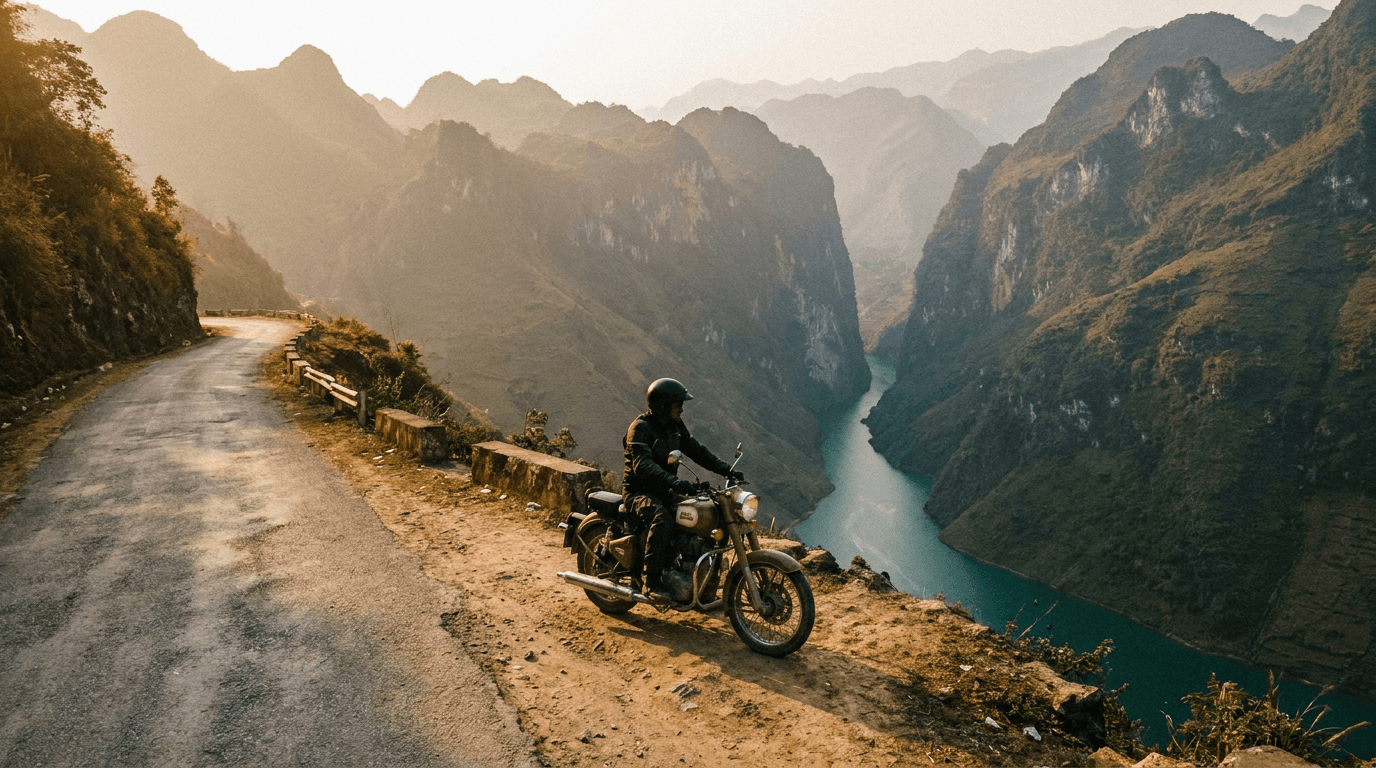
Vietnam's bucket-list ride. The Hà Giang Loop is a 350km motorcycle circuit in the country's northernmost province, climbing through karst mountain landscapes, terraced rice paddies, and ethnic-minority villages near the Chinese border. The signature section is the Mã Pí Lèng Pass — a 20km cliff-edge road carved into the Nho Quế River canyon with vertical drops over 700m, considered one of Vietnam's four great passes. Typically ridden over 3-4 days from Hà Giang city through Đồng Văn, Mèo Vạc, and back. Locally-rented Honda XR150s or semi-automatic Honda Wins are standard. Easyrider services pair you with a local driver if you can't ride. Best ridden October-April (dry season); avoid May-September monsoon.
Vietnam's most globally famous driving road. The Hải Vân Pass (the "Ocean Cloud Pass") runs 21km along the QL1 between Huế and Đà Nẵng, climbing to 496m with sweeping views over the South China Sea on one side and the Trường Sơn Mountains on the other. Made internationally famous by the 2008 Top Gear Vietnam Special, which described it as "one of the best coastal roads in the world." The pass takes 45-60 minutes to drive, though most travellers stop at the Don Ca Hải Vân viewpoint. Cars and trucks use the new Hai Van Tunnel; motorbikes are restricted to the original pass road — quieter, slower, properly scenic. Best driven April-September during dry season.
Vietnam has 65 million motorbikes for 100 million people — one of the highest densities on Earth. The motorcycle is the dominant mode of transport, the cultural touchstone, and the way most international visitors experience Vietnam at depth. Three iconic machines define the scene: the Honda Cub (the basic step-through in continuous use since 1961, the bike that motorised Vietnam), the Honda Wave (modern semi-automatic descendant), and the Honda Win 110 (the basic manual that backpackers use for coast-to-coast trips). Beyond the bikes, the wider culture: the dawn pho stops with rows of parked bikes, the family-of-five Cub passing you in Saigon, the Sunday meet-ups at coffee houses, and the ubiquitous tin-roof repair shops that can fix anything for $5.
The Hồ Chí Minh Highway (Highway 14) is Vietnam's classic north-south alternative to the coastal QL1 — a 2,000km route running through the Trường Sơn Mountains and central highlands from Hanoi to Ho Chi Minh City. The historical route follows the original Ho Chi Minh Trail (the supply lines used during the Vietnam War), passing through Phong Nha (the spectacular cave region of Phong Nha-Ke Bang National Park), Khe Sanh (former US Marine combat base), the central highlands at Đà Lạt, and the coffee-growing region around Buon Ma Thuot. Less traffic than QL1, more elevation change, dramatic forest landscapes. Typically done over 7-10 days by motorbike or 4x4. Best driven November-April.
Vietnam's automotive story is being rewritten in real time. VinFast (founded 2017 as Vingroup's automotive division) is the country's first major domestic carmaker — the Hải Phòng plant builds the VF3, VF6, VF8, and VF9 electric SUVs, plus the VF e34. VinFast began US sales in 2023 and has built dealerships across North America, Europe, and Asia. The brand has become a symbol of Vietnam's rapid modernisation. Plus the Thành Công-Hyundai joint venture in Ninh Bình (the country's largest car producer by volume), and Toyota's Vietnam plant building Hilux pickups. The traditional car market remains small (cars are heavily taxed in Vietnam), but the rich Vietnamese supercar scene around Saigon and Hanoi is increasingly visible — the rapid wealth growth has created an unexpectedly strong domestic luxury car market.
Vietnamese urban traffic is a defining automotive experience. Hanoi and Ho Chi Minh City (Saigon) have some of the world's most distinctive traffic cultures — millions of scooters moving in choreographed chaos, with cars threading between them, pedestrians crossing through traffic flow rather than waiting for gaps, and horn use as positional communication rather than aggression. The Old Quarter in Hanoi and District 1 in Saigon are the most intense — standing on a corner watching the flow is an experience in itself. Crossing the street is a learnable skill: walk at constant pace, don't run, don't stop, traffic flows around you. Honda Cub, Honda Wave, Yamaha Sirius, and Piaggio Vespa LX scooters dominate. Genuinely fascinating to observe; only ride if you've genuinely ridden in traffic before.